

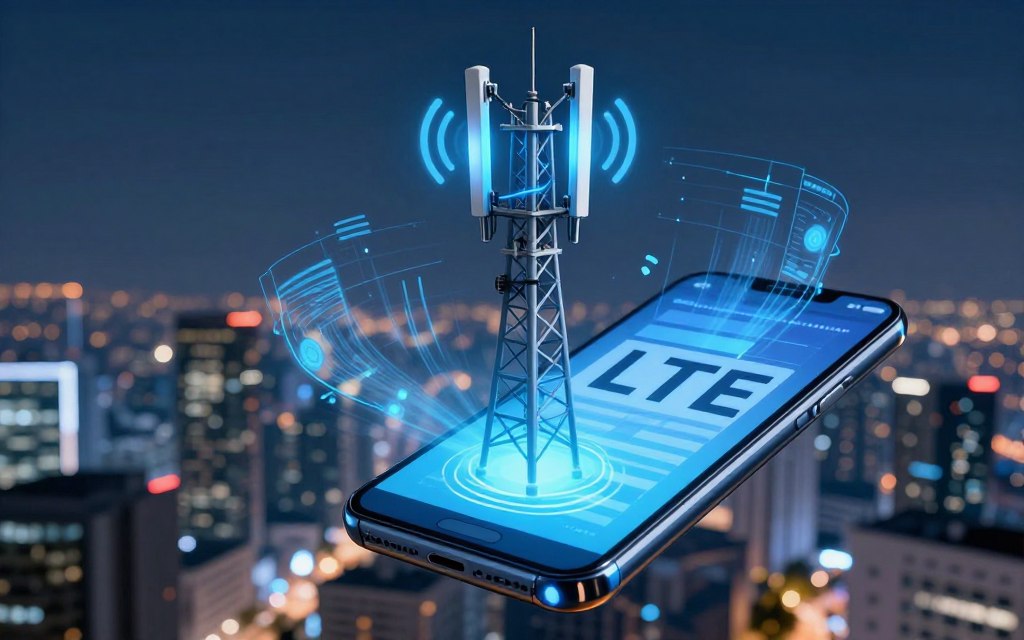
Long Term Evolution, or LTE, is a major advance in cellular standards. This fourth-generation framework supports most mobile data connections across the United States today. The 3rd Generation Partnership Project (3GPP) created LTE to provide faster data rates, lower latency, and better spectral efficiency than 3G.
This guide explains what is lte wireless technology and how LTE cellular technology works. It compares LTE with 4G and 5G technologies and examines frequency bands used by Verizon, AT&T, and T-Mobile. It also explains 4G LTE speed in daily use and LTE’s continued growth alongside emerging 5G networks.
The following sections cover LTE network architecture and FCC allocations of the frequency spectrum. LTE forms the backbone of modern mobile connectivity, so its basics matter in today’s digital world.
Key Takeaways
- LTE is the fourth-generation cellular standard, enhancing mobile data connectivity.
- It offers faster data rates and lower latency compared to previous technologies.
- Major U.S. carriers utilize specific frequency bands for LTE deployment.
- Understanding LTE is vital for grasping the evolution toward 5G networks.
- Real-world speeds can vary based on network conditions and carrier infrastructure.
- For more insights on hybrid wireless technology, visit this link.
What Is LTE Wireless Technology? Defining the Standard
LTE wireless technology marks a major advance in mobile communication. It stands for Long Term Evolution, which describes a major step in cellular network development. 3GPP first standardized LTE in Release 8 of its specifications in 2008.
Commercial deployments began in 2009. The technology was designed to help carriers move smoothly from earlier 3G technologies, including UMTS and HSPA.
The Meaning Behind the LTE Acronym
The LTE acronym points to long-term evolution in mobile networks. This LTE cellular technology reflects ongoing improvements as mobile data needs grow. LTE network infrastructure uses a flat and IP-based architecture, which lowers latency and improves the user experience.
LTE also supports scalable bandwidth options from 1.4 MHz to 20 MHz for many applications and services.
Why LTE Became the Global Mobile Standard
LTE became the dominant global mobile standard because major carriers worldwide adopted it. In the United States, these carriers included Verizon, AT&T, T-Mobile, and Sprint.
Its technical advantages, including support for both FDD and TDD duplexing, attracted carriers facing exploding mobile data demand. LTE unified the fragmented 3G landscape, becoming the first truly global cellular standard.
Related Posts:
- What is 2.4 GHz Wireless Technology? Understanding…
- What Is De Facto Technology Unwritten Industry Standards

- How Science and Technology Affect Our Lives…

- How Does Technology Help Cater to Individual Student…
- What Is a Bachelor of Science in Information…

- Does Technology Benefit Society The Impact on Modern Life

| Feature | Description | Advantage |
|---|---|---|
| Architecture | Flat IP-based | Reduced latency and improved efficiency |
| Bandwidth Options | 1.4 MHz to 20 MHz | Flexible scalability for various services |
| Duplexing Support | FDD and TDD | Versatile deployment options for carriers |
The Evolution of Mobile Networks: From 1G to LTE
Mobile networks evolved from 1G to LTE, bringing faster service and better user experiences. Each generation increased speed and capacity. Understanding LTE network architecture helps explain the LTE cellular technology used today.
Generations of Cellular Technology
Mobile networks moved through several generations:
| Generation | Technology | Key Features | Year Introduced |
|---|---|---|---|
| 1G | AMPS | Analog voice calls | 1983 |
| 2G | GSM, CDMA | Digital voice and SMS | Early 1990s |
| 3G | UMTS, EV-DO | Mobile data and early smartphone browsing | Early 2000s |
| 4G | LTE | True mobile broadband | 2010 |
Each generation improved mobile data speed and expanded available features. The move from 1G to 4G LTE changed basic voice service into expected high-speed internet access.
The Transition from 3G to LTE in the United States
The rapid 3G-to-LTE shift marked a major step in U.S. mobile technology. Verizon launched LTE in December 2010, covering 38 metropolitan areas. AT&T followed in 2011, Sprint in 2012, and T-Mobile in 2013, making the U.S. one of the fastest adopters globally.
Competition drove LTE adoption, improved service, and raised 4G LTE speed, delivering faster 4G LTE speeds. The shutdown of legacy 3G networks between 2022 and 2023 made LTE the baseline connectivity standard for American mobile users. This evolution improved user experience and laid groundwork for future mobile technology.
How LTE Technology Works: The Core Architecture
Understanding LTE network architecture requires a look at its core design. It uses advanced methods to improve speed and efficiency. OFDMA and SC-FDMA are its two key modulation schemes.
OFDMA and SC-FDMA: The Foundation of LTE
OFDMA divides available spectrum into many narrow subcarriers for downlink data. This lets many users share the network and improves spectral efficiency. It also resists multipath interference, which often affects urban areas.
SC-FDMA handles uplink transmissions. It lowers the peak-to-average power ratio, helping preserve smartphone battery life. Devices can send data efficiently without draining power too quickly.
The Role of eNodeB in LTE Networks
LTE base stations use the eNodeB, or Evolved Node B, to connect devices. It replaces the older Node B and Radio Network Controller architecture used in 3G networks. It manages several critical network functions:
- Radio resource management
- Scheduling user data transmissions
- Making handover decisions
- Handling encryption for secure communications
This simpler design reduces network complexity and latency. It creates a better user experience.
LTE Network Architecture Explained
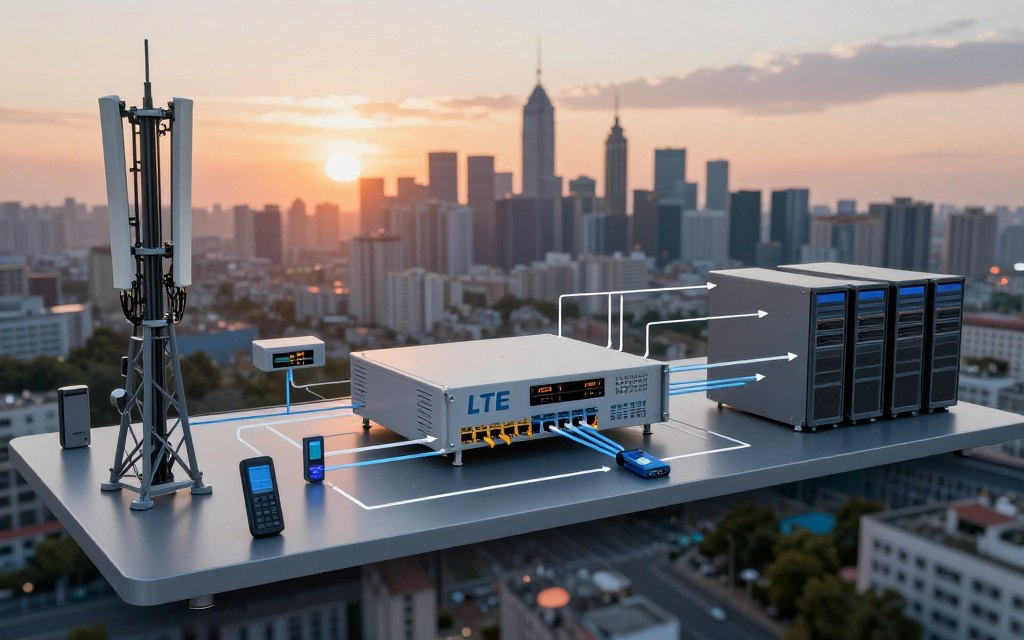
The complete LTE network architecture centers on the Evolved Packet Core (EPC). This core includes several key components:
- Mobility Management Entity (MME): Manages signaling and authentication.
- Serving Gateway (SGW): Routes user data traffic.
- Packet Data Network Gateway (PGW): Connects to external networks.
- Home Subscriber Server (HSS): Maintains subscriber information.
Together, these components provide steady connections and handle data efficiently. This teamwork makes LTE a strong choice for mobile communications.
LTE vs. 4G vs. 5G: Key Differences Explained
An LTE vs 5G comparison helps consumers navigate mobile technology. These terms often seem interchangeable, but they describe different technologies, capabilities, and performance levels.
Is LTE the Same as 4G?
Many consumers think LTE means 4G. However, original LTE (3GPP Release 8) failed to meet the International Telecommunication Union’s (ITU) IMT-Advanced requirements. The ITU’s standard set 4G LTE speed targets: 100 Mbps for high mobility and 1 Gbps for low mobility.
Only LTE-Advanced (Release 10 and later) met these requirements. In the United States, carriers often market it as “4G LTE,” a term consumers connect with fourth-generation mobile broadband. The ITU later recognized LTE-Advanced as a legitimate 4G technology.
How LTE Compares to 5G Technology
Compared with LTE, 5G introduces several major advances, including:
- Millimeter Wave Spectrum: Utilizing frequencies of 24 GHz and above, 5G offers multi-gigabit speeds.
- Network Slicing: This capability allows for customized network experiences tailored to specific needs.
- Ultra-Reliable Low-Latency Communication (URLLC): Essential for mission-critical applications, this feature ensures minimal delays.
- Massive Machine-Type Communications (mMTC): Designed for IoT at scale, enabling a higher density of connected devices.
5G’s theoretical speed reaches 20 Gbps, compared with 3 Gbps for LTE-Advanced Pro. LTE remains the backbone of American mobile connectivity, offering broad coverage and useful LTE download speeds. 5G has yet to match LTE’s coverage, especially in rural areas.
LTE Frequency Bands Used in the United States
Understanding LTE frequency bands helps explain how mobile networks work in the United States. These bands shape service quality, coverage, and overall LTE performance. The U.S. spectrum has three tiers: low-band, mid-band, and high-band, each with different uses.
Low-Band, Mid-Band, and High-Band Spectrum
Low-band spectrum operates below 1 GHz and includes 600 MHz, 700 MHz, and 850 MHz. It provides strong coverage and building penetration but usually has limited capacity. That limit can reduce data speeds during peak use.
Mid-band spectrum ranges from 1 to 6 GHz and balances coverage with capacity. It includes AWS 1700/2100 MHz, PCS 1900 MHz, and 2.5 GHz. This band is vital in cities where data demand is high.
High-band spectrum operates above 6 GHz and provides the highest throughput. However, its range is limited, so it works less well for rural coverage. Carriers mainly use it in dense areas where people want faster data speeds.
Major US Carriers and Their LTE Bands
U.S. carriers use LTE bands strategically. Verizon mainly uses Band 13 (700 MHz) for broad coverage, plus Bands 2, 4, and 66 for capacity. AT&T’s bands include 12/17 (700 MHz) for coverage, 14 for FirstNet public safety communications, and 2, 4, 30, and 66.
T-Mobile has expanded its reach with Band 71 (600 MHz), which provides extended range. It also uses Band 12 and Bands 2, 4, 41, and 66 for strong network service. This mix of LTE bands strengthens LTE network infrastructure and improves customer service.
LTE carrier aggregation lets providers combine multiple bands. It treats separate frequency blocks as one wider channel, allowing faster speeds and better performance. This technology helps meet the growing demand for mobile data.
LTE Speed and Performance: What to Expect
Knowing expected LTE speeds can improve your mobile connection. LTE offers impressive theoretical peak speeds, but actual performance varies for many reasons. This difference matters to people who use mobile networks every day.
Peak Download and Upload Speeds
3GPP specifications define LTE’s theoretical peak speeds. LTE Category 4 supports up to 150 Mbps for downloads and 50 Mbps for uploads. LTE-Advanced (Category 6 and above) can use LTE carrier aggregation, or carrier aggregation, to reach speeds from 300 Mbps to 1 Gbps.
The most advanced version, LTE-Advanced Pro (Category 16 and above), can theoretically reach an astounding 3 Gbps download speed.
Peak speeds require ideal conditions. Proximity to the cell site, low network congestion, and a capable device help users reach them. Users should also consider the spectrum bandwidth available in their area.
Real-World LTE Performance Across America
In reality, average LTE download speeds in the United States typically range from 30 to 60 Mbps, depending on the carrier and location. Urban areas generally perform better than rural regions. Major carriers like Verizon, AT&T, and T-Mobile have invested heavily in LTE-Advanced features, including 4×4 MIMO, 256 QAM, and carrier aggregation.
These features enhance real-world throughput. Peak-hour congestion, signal attenuation from buildings, and distance from cell towers can affect your 4G LTE speed. Knowing these factors helps users set realistic expectations for LTE speeds throughout the day.
| Carrier | Average Download Speed (Mbps) | Peak Download Speed (Mbps) |
|---|---|---|
| Verizon | 50 | 1,000 |
| AT&T | 45 | 800 |
| T-Mobile | 55 | 900 |
LTE Network Components and Infrastructure
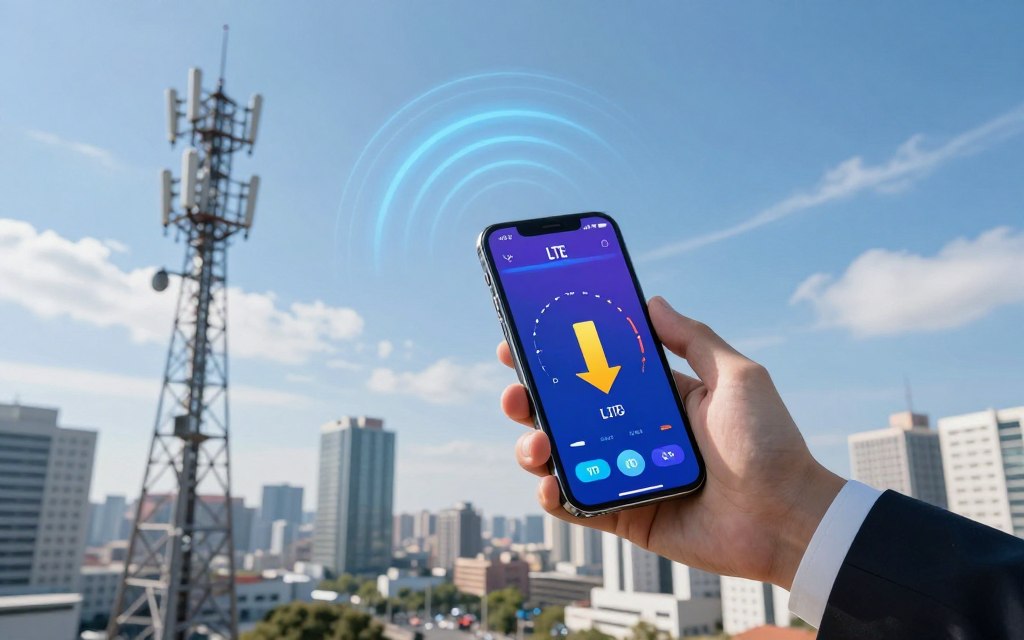
The LTE network infrastructure uses several components to deliver connectivity. These parts help explain how LTE networks work. This section covers LTE base stations and the Evolved Packet Core (EPC).
Base Stations and Cell Towers
LTE base stations, also called eNodeBs, support mobile communication. Each eNodeB has radio transceivers, antennas, and baseband processing units. These units communicate directly with user devices.
eNodeBs form overlapping coverage areas called cells. Urban cells usually range from 0.5 to 5 kilometers in radius. Rural cells can extend up to 30 kilometers or more.
Tower placement helps users maintain seamless connectivity. eNodeBs connect to the core network through high-capacity backhaul links. These links often use fiber optic or microwave connections.
Distributed antenna systems (DAS) and small cells support macro towers. They are useful in dense urban areas, stadiums, and indoor venues.
The Evolved Packet Core (EPC)
The Evolved Packet Core (EPC) advanced LTE network architecture. It is an all-IP core network that replaced the circuit-switched 3G core. The EPC includes several key components:
| Component | Function |
|---|---|
| Mobility Management Entity (MME) | Handles signaling, authentication, and tracking area updates. |
| Serving Gateway (SGW) | Routes user data packets within the network. |
| Packet Data Network Gateway (PGW) | Provides the interface to external networks like the internet. |
| Home Subscriber Server (HSS) | Stores subscriber profiles and authentication credentials. |
| Policy and Charging Rules Function (PCRF) | Enforces quality of service and billing policies. |
This flat, simpler architecture reduces latency and operating costs. It performs better than legacy 3G networks. The Evolved Packet Core helps LTE networks deliver high-speed data and efficient communication.
LTE Security Features and Data Protection
In an age of data breaches and cyber threats, understanding LTE security features is crucial. LTE network architecture uses LTE security protocols to protect user data and support safe communication. These features protect network integrity and user privacy.
A key part of LTE security is its encryption and authentication protocols. The Authentication and Key Agreement (AKA) protocol is central to this process and mutually authenticates the device and network. It checks credentials from the Universal Subscriber Identity Module (USIM) and Home Subscriber Server (HSS), allowing authorized devices access.
Additionally, LTE employs 128-bit Advanced Encryption Standard (AES) encryption for both user data and signaling traffic. These LTE encryption standards are much stronger than algorithms used in earlier generations, such as 2G and 3G. During authentication, separate keys are created:
- K_eNB for radio interface encryption
- K_NAS for non-access stratum signaling
- K_UP for user plane data
However, LTE has vulnerabilities. Common LTE vulnerabilities include:
- IMSI catchers (stingrays) that exploit the pre-authentication transmission of the International Mobile Subscriber Identity.
- Denial-of-service attacks targeting the radio interface.
- Weaknesses in the SS7 signaling network, which can be exploited for location tracking or call interception.
To reduce these risks, several measures are being used. Newer 3GPP releases encrypt the IMSI, while 5G offers a stronger security architecture. Carriers also deploy security monitoring systems to improve network protection.
In conclusion, LTE security protocols defend against many threats. Ongoing vigilance and technology advances remain essential for protecting user data. For more insights into how LTE is used in various sectors, check out this public safety LTE initiative.
LTE Use Cases Across the United States
LTE technology has changed how Americans connect and communicate across many sectors. It reaches beyond smartphones, shaping daily activities and critical services.
Consumer Mobile Broadband
One major use of LTE is consumer mobile broadband. This service supports video streaming on platforms like Netflix and YouTube, social media browsing, and mobile gaming.
Many Americans now use LTE mobile broadband as their main internet connection. This trend is clear among households that have “cut the cord” from traditional broadband services.
IoT and Machine-to-Machine Communications
LTE also supports IoT and machine-to-machine (M2M) communications. Specialized variants, including LTE-M (LTE Cat-M1) and NB-IoT (Narrowband IoT), serve low-power, low-data-rate devices.
LTE IoT connectivity enables smart meters, asset trackers, agricultural sensors, and connected vehicles. These devices can have battery life exceeding ten years and maintain strong connections through existing LTE network infrastructure.
Public Safety and Rural Connectivity Initiatives
LTE also plays a key role in public safety and rural connectivity initiatives. FirstNet is a dedicated public safety broadband network developed by AT&T with the federal government. Using Band 14 spectrum, FirstNet gives first responders priority communications during emergencies.
The FCC’s Connect America Fund has significantly improved LTE coverage in previously underserved rural communities. T-Mobile’s deployment of the 600 MHz Band 71 has also improved coverage across the United States.
The Future of LTE: Coexistence with 5G Networks
As mobile networks evolve, LTE will work alongside 5G networks. The LTE vs 5G transition will improve user experiences and support a smooth shift between networks. LTE Advanced and LTE Advanced Pro lead this change.
LTE Advanced and LTE Advanced Pro
LTE Advanced (3GPP Release 10–12) and LTE Advanced Pro (Release 13–14) add major performance improvements, including LTE carrier aggregation. These include:
- Carrier Aggregation: Combining up to 32 component carriers for increased bandwidth.
- MIMO Configurations: Utilizing 4×4 and 8×8 MIMO antenna setups for improved signal quality.
- 256 QAM Modulation: Enhancing data throughput for better user experiences.
- License Assisted Access (LAA): Utilizing unlicensed spectrum to improve capacity.
- Vehicle-to-Everything (V2X) Support: Enabling communication between vehicles and infrastructure.
These upgrades help LTE Advanced Pro reach theoretical peak speeds of up to 3 Gbps. That makes it a strong technology even as 5G rolls out.
How LTE Supports 5G Deployment in the US
In the United States, LTE supports 5G deployment in several ways:
- Non-Standalone (NSA) Architecture: This model uses LTE as the anchor for control signaling while 5G NR handles data transmission.
- Dynamic Spectrum Sharing (DSS): Carriers can use the same spectrum for both LTE and 5G simultaneously, maximizing efficiency.
- Fallback Coverage: LTE provides essential coverage when 5G signals are unavailable, ensuring continuous connectivity.
Continued investment in LTE infrastructure means it will remain vital to American mobile networks for at least the next decade. The partnership between LTE and 5G is essential for seamless user connectivity.
Conclusion
Knowing what is lte wireless technology helps people navigate today’s mobile world. LTE cellular technology forms the backbone of American mobile connectivity, offering fast, reliable internet access. It uses OFDMA and SC-FDMA to improve data transmission efficiency.
4G LTE speed supports smooth streaming, browsing, and communication. Major carriers, including Verizon, AT&T, and T-Mobile, built broad networks across several frequency bands. These networks provide coverage in rural areas, helping consumers and businesses.
Although 5G technology brings a major advance, LTE will remain important for years. It supports everyday smartphone use, critical IoT services, and public safety communications. Understanding LTE fundamentals helps users make informed choices in a changing digital world.