

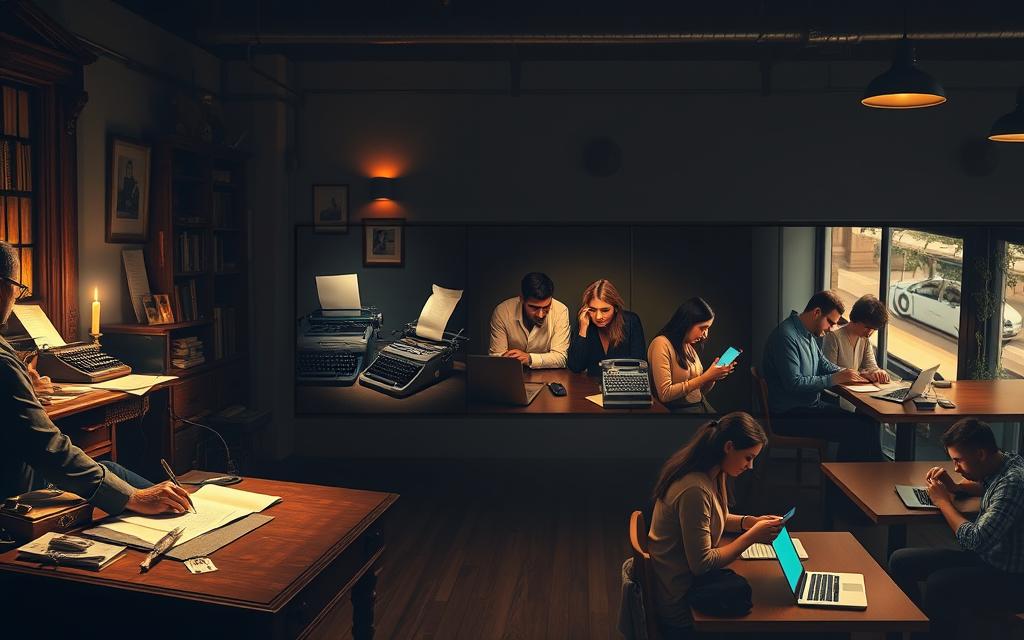
Human connection is a basic need. Over centuries, our ways of connecting have changed a lot.
The move from smoke signals to instant messaging is amazing. It shows how communication has evolved. This change has changed how we talk and share news.
Now, we communicate almost instantly. This big change is a key part of our history of communication technology.
Looking at this change helps us see how tech has changed us. We’ll explore how tech keeps changing how we connect.
The Age of Written Correspondence and Postal Systems
For centuries, written letters were the main way to stay connected over long distances. This time in postal history is a captivating story of growth from messy messenger systems to well-organised mail services. These changes greatly affected how people communicated.
Early Methods: Couriers and Postal Routes
Before the start of formal postal services, sending messages was hit-or-miss. Messengers used various ways like walking, riding horses, or sailing to deliver written letters. They faced many obstacles like bad weather, robbers, and tough paths.
Getting messages through was not always easy. Important messages were often sent in multiple copies through different paths. The creation of set postal routes was a big step forward in making long-distance communication better.
The Penny Post and Democratisation of Mail
In 1840, the Penny Post in Britain changed the game for mail. It made sending letters within the country for just one penny possible. Before, the cost of sending mail was too high for most people.
Related Posts:
- How Technology Affects Our Daily Lives A Comprehensive Essay

- Does Technology Benefit Society The Impact on Modern Life

- How Technology Affects Family Communication Digital…

- How Science and Technology Affect Our Lives…

- How Technology Is Bad For Us The Negative Side Effects

- The Most Important Technologies Shaping Our World

This change made snail mail accessible to everyone. Suddenly, writing letters was something ordinary people could do. The postal service grew fast as millions took advantage of this new way to communicate.
Social Significance of Letter Writing Culture
Letter writing became more than just sending information. Letters were seen as precious, carrying personal thoughts and feelings. Their physical form made them special.
People put a lot of effort into writing meaningful letters. The wait to get a letter was exciting. This way of communicating built stronger bonds than today’s fast messaging.
Many families kept their letters as keepsakes and historical records. These letters give us a peek into the past, showing us how people lived and related to each other. The value of letter writing is clear in the letters of famous people and everyday folks.
The Telegraph Revolution: First Instant Long-Distance Communication
In the mid-19th century, a major change happened in how we communicate. Gone were the days of messages carried by horses or ships. Now, electrical signals could send thoughts across long distances in just minutes. This revolution changed how societies worked and connected.
Morse Code and Electrical Telegraph Systems
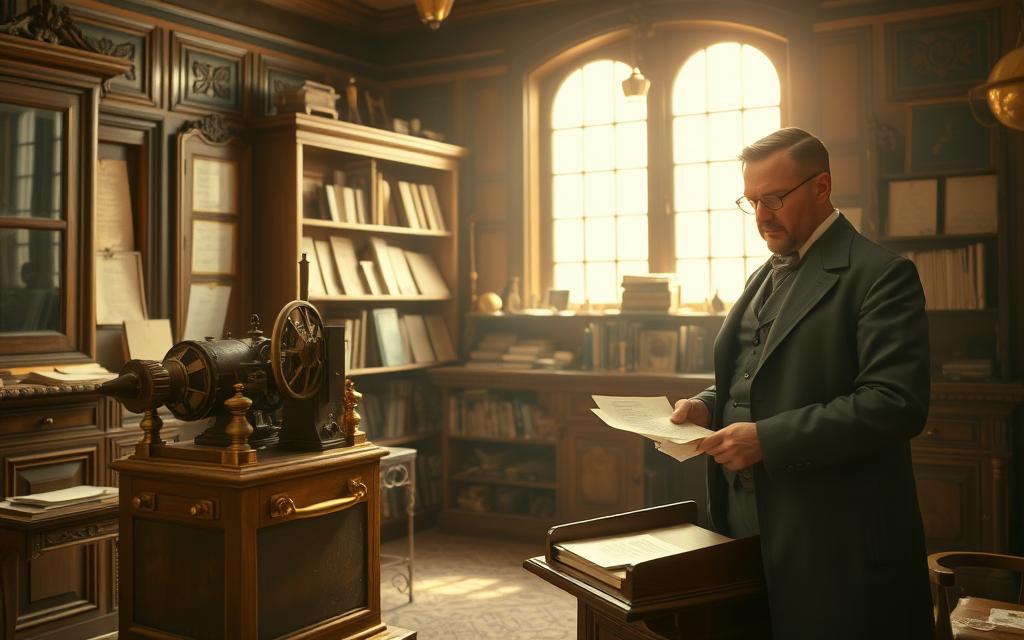
Samuel Morse didn’t just invent the telegraph. He also created Morse code, a system that turned messages into simple electrical signals. These signals were dots and dashes that stood for letters and numbers.
Operators became experts at tapping out messages. These messages could travel hundreds of miles through wires. The system was simple yet powerful, marking the start of real-time messaging.
“What hath God wrought?” – the first official message sent by Morse’s telegraph in 1844, capturing the awe of this breakthrough.
Transatlantic Cables and Global Connectivity
The biggest telegraph project was the transatlantic cable. After many failed tries, the first successful cable was laid in 1866. It connected Europe and North America instantly.
This achievement made the world feel smaller. News that used to take weeks to cross the ocean now arrived in hours. It showed humanity’s growing control over distance and time, paving the way for our connected world today.
Business and Journalism Transformations
The telegraph changed business and journalism a lot. Companies could manage operations over long distances quickly. They could also respond to market changes fast.
Journalism saw the biggest change. Newspapers could report on events happening on the other side of the world in their next edition. This led to the creation of news agencies like Reuters and Associated Press, which used telegraph networks to gather and share information.
| Industry | Pre-Telegraph Communication | Post-Telegraph Communication |
|---|---|---|
| Shipping & Logistics | Weeks for shipment coordination | Hours for route adjustments |
| Financial Markets | Regional price variations common | National price standardisation |
| News Reporting | Days or weeks for distant news | Same-day reporting possible |
| Military Operations | Messengers on horseback | Instant command coordination |
The telegraph invention set the stage for future communication technologies. It showed how fast information exchange could change economics, politics, and social connections. Samuel Morse‘s creation didn’t just send messages. It launched us into the era of instant communication.
Telephone Technology: Voice Communication at a Distance
The way we talk to each other changed a lot with the invention of the telephone. Unlike telegraphs, which used codes, phones let us talk in real time. We can share feelings and get instant responses.
Bell’s Patent and Early Telephone Exchanges
Alexander Graham Bell got a patent for the telephone in 1876. This was a big step in how we communicate. His invention turned electrical signals into words we can understand.
At first, phones needed manual switchboards. These were run by operators who connected calls with patch cords. This was how the first voice networks were made.
The Spread of Residential Telephone Services
Phones were first for businesses and the rich. But by the 1920s, they became more common. This was thanks to better technology and more phone lines.
In the mid-1900s, phones became a normal part of homes. They let families and friends talk across cities and countries. This was a big change in how we stay in touch.
Changing Social Patterns and Business Practices
Phones changed how we talk to each other. We could share news right away, not wait for letters. This made conversations more spontaneous.
Businesses also changed a lot with phones. Sales, customer service, and management got better with direct talk. It made everything more efficient.
Phones let us hear each other’s emotions, making connections deeper. This changed how we keep in touch with people far away.
Wireless Communication: Radio Broadcasting Emerges
The world of communication changed forever with wireless technology. It made sending information through the air possible. This new way of sharing news and shows changed society.
Marconi’s Experiments and Radio Development
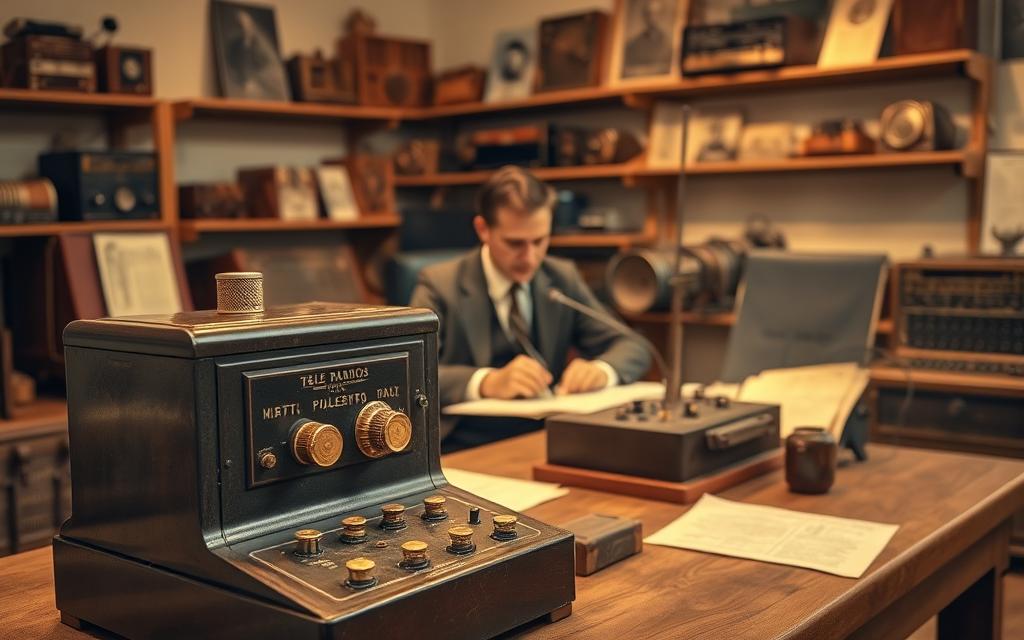
Guglielmo Marconi was a key figure in radio history. He showed that wireless signals could travel far. His early work proved messages could be sent without wires.
In 1895, Marconi sent signals about two kilometres. This was the start of wireless telegraphy. He kept improving, sending signals across the English Channel in 1899.
His biggest achievement was in 1901. Marconi sent a signal from Cornwall to Newfoundland. This showed radio waves could go around the Earth, changing what scientists thought was possible.
Mass Communication and Entertainment Revolution
Radio technology grew fast. By the 1920s, broadcast media was born. Stations started sending out shows to everyone.
Families listened to music, drama, and news together. This was a new way to share experiences. People could hear the same things all over the country.
Radio created new jobs and industries. In the US, ads paid for shows. Radio stars became famous, and families planned their evenings around their favourite shows.
Emergency Services and Military Applications
Wireless tech was key for safety and security. It helped ships talk to shore and each other. This made the sea safer, with quicker warnings and calls for help.
In World Wars I and II, radio was vital for the military. It let commanders give orders instantly. This was a game-changer for military operations.
Emergency services soon used radio too. Police, fire, and ambulances could talk to each other right away. This made them respond faster in emergencies.
Guglielmo Marconi’s work laid the groundwork for today’s media. His ideas about sending information through the air have shaped how we get news and entertainment.
Television: Visual Mass Communication Arrives
The flickering box in the living room became the twentieth century’s most influential storyteller. Television changed how we get information and entertainment. It brought shared experiences across the world through moving images.
Technical Evolution from Mechanical to Electronic TV
Early TV used mechanical scanning with rotating discs. Scottish inventor John Logie Baird showed the first working TV in 1926. These early systems had low quality and needed bright lights.
Then, electronic TV came along thanks to Philo Farnsworth and Vladimir Zworykin. Their cathode ray tube technology improved picture quality and made broadcasting practical. This was the start of modern TV technology.
Broadcast Networks and Programme Distribution
Big networks like BBC in Britain and NBC/CBS in America started broadcasting nationwide. They had standardised schedules that reached millions at once. This made the first mass media audience.
Distribution methods grew from local to national, using coaxial cables and microwave relays. The table below shows key developments in TV distribution:
| Era | Distribution Method | Coverage Range | Key Networks |
|---|---|---|---|
| 1930-1940s | Local Broadcast | City-wide | BBC, DuMont |
| 1950-1960s | Coaxial Cable | National | CBS, NBC, ABC |
| 1970s-present | Satellite Transmission | Global | CNN, Sky, BBC World |
Cultural Impact and News Dissemination
Television gave us common cultural references through popular shows and events. Families watched entertainment, sports, and news together. This shared experience shaped our national identities and memories.
News reporting changed with TV’s visual coverage of world events. The visual media impact made global conflicts feel close and personal. TV journalism became the main source of news for many.
Big events like moon landings and royal weddings got huge viewership. TV’s ability to show reality changed how we see news. This visual immediacy created strong emotional connections to current events.
Computer Networks: The Digital Foundation
Before, communication breakthroughs connected people. But the digital revolution changed this by connecting machines. This shift laid the groundwork for a new era in global communication.
The path to modern computer networking began with simple data transfers. Researchers and engineers worked to share information between machines. This laid the foundation for more complex networks.
Early Computing and Data Transmission
In the 1950s and 1960s, computers were isolated. The idea of connecting them grew through time-sharing systems and early network tests. These early links used dedicated phone lines or cables to move data.
Modems were key in converting digital signals into tones for phone networks. This allowed the first remote computer connections, though they were slow.
ARPANET and Internet Protocol Development
The ARPANET history marked a key moment in digital communication. It was a US Department of Defense project that started the first packet-switching network in 1969.
Packet switching split data into smaller units for independent travel. This method was more reliable and efficient than circuit-switching.
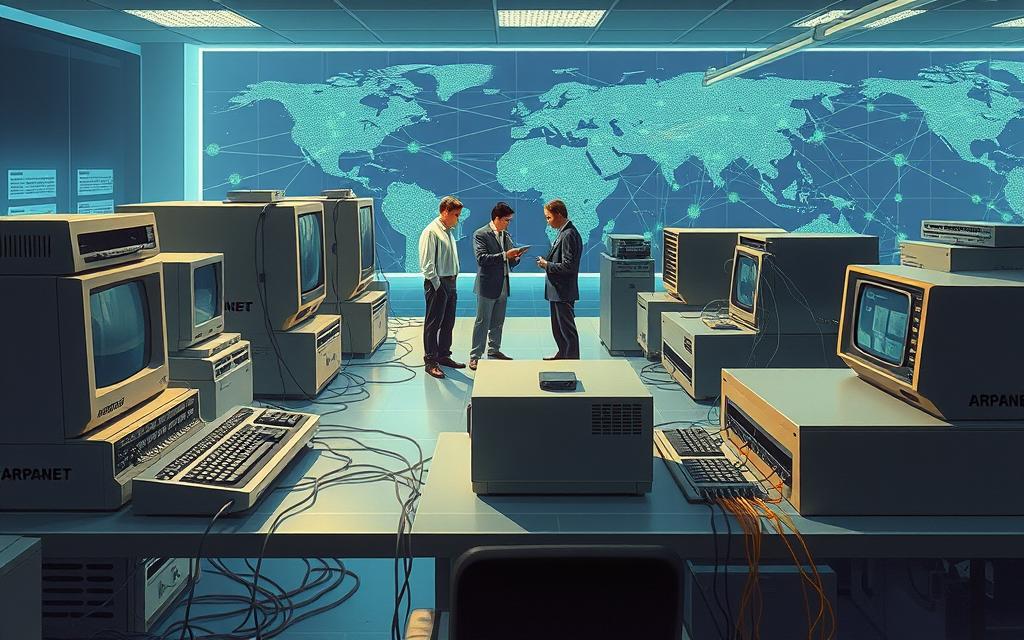
The TCP/IP protocol in the 1970s gave a common language for networks. It allowed different systems to talk to each other, laying the groundwork for the modern internet.
Local Area Networks and Business Communications
Wide-area networks connected distant places, but businesses needed something else. LAN development brought technologies like Ethernet in the 1970s.
Local Area Networks changed offices by allowing:
- Shared access to expensive hardware like printers
- Centralised file storage and collaboration
- Internal email systems before the internet
These networks made digital workplaces efficient. They later connected to the global internet. Businesses saw big benefits in productivity and cost savings.
The growth of computer networking built the foundation for all digital communication advancements. From these beginnings, our connected world today emerged.
Email: The Digital Replacement for Letters
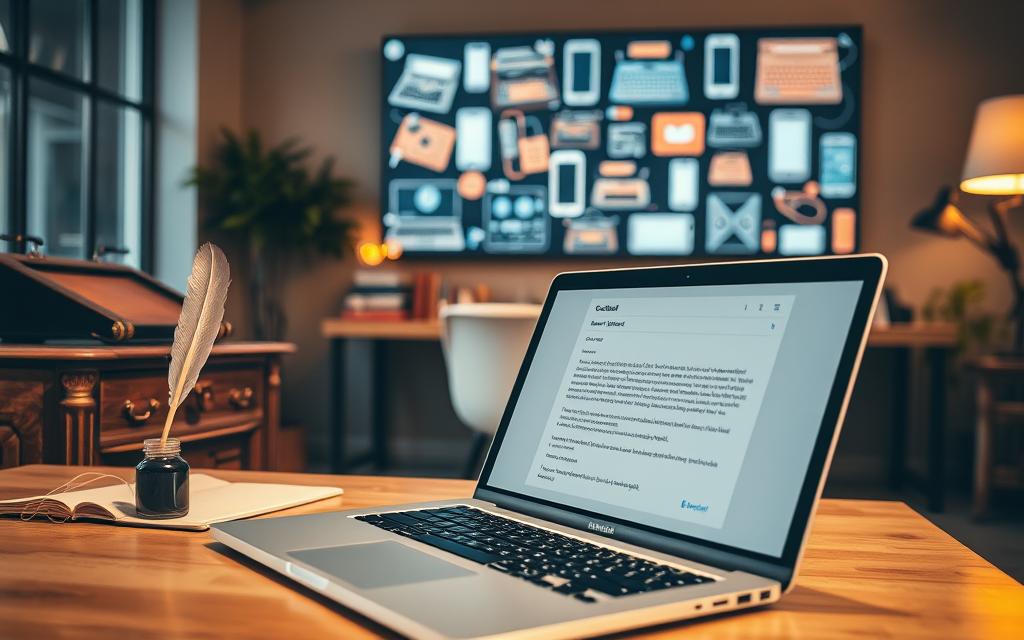
Email changed how we send messages from days to seconds. It lets us send messages instantly anywhere. Unlike old postal systems, emails can send documents and photos too.
Ray Tomlinson and the @ Symbol
In 1971, Ray Tomlinson made the first email system. He used the @ symbol to separate names from addresses. This simple idea is used today.
Tomlinson’s work made sending messages between computers easy. His use of the @ symbol is a key part of digital communication.
Corporate Adoption and Standardisation
Businesses saw email’s value for better communication. By the 1980s and 1990s, email use grew fast. Companies could talk to each other instantly, not waiting for mail.
Standards like SMTP came in 1982. These rules helped different email systems talk to each other. Easy-to-use interfaces made email simple for everyone.
Changing Communication Patterns and Expectations
Email changed how we expect to communicate. Emails need quick answers, unlike letters. This made business faster but also put pressure on quick replies.
Some said email lacks the personal touch of letters. Emails feel more temporary than handwritten notes. But, the benefits of email’s speed won out for most.
Email’s speed changed how we connect globally. It became the main way to communicate in many fields.
| Aspect | Traditional Letters | Impact of Change | |
|---|---|---|---|
| Delivery Time | Days or weeks | Seconds or minutes | Faster decision-making |
| Cost | Postage fees per item | Minimal ongoing costs | More frequent communication |
| Attachment Capability | Physical enclosures | Digital files | Easier document sharing |
| Record Keeping | Physical storage | Digital archives | Improved organisation |
| Global Reach | Limited by postal routes | Instant worldwide | Expanded business opportunities |
The move from mail to email is a big change in history. Email mixes the thought of letters with the speed of phones. It opened new ways for us to connect.
Mobile Revolution: Communication Becomes Personal and Portable
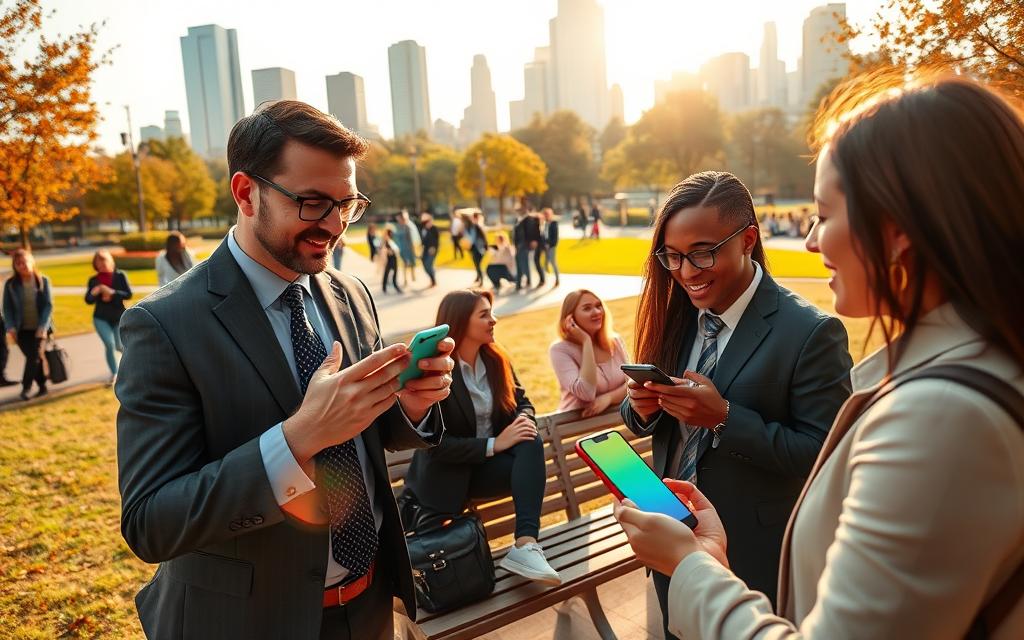
The late 20th century saw a big change in how we talk to each other. Mobile phones made it possible to chat anywhere, not just at home. These devices started big and have now shrunk to the smartphones we use today.
From Car Phones to GSM Networks
Early mobile phones were huge and not easy to carry. They needed big batteries and took up a lot of space in cars. These phones used old technology and didn’t cover much area.
Then, digital GSM networks came along. This new system was made in Europe and became the standard for mobile phones worldwide. GSM brought:
- Secure digital voice transmission
- International roaming capabilities
- Better call quality and capacity
As more people wanted mobile phones, networks grew. They covered more areas, including rural places. Mobile phones became personal devices for everyone.
SMS: The Unexpected Messaging Revolution
Short Message Service started as a small part of GSM. But it became a big deal. SMS let people send short messages anytime, anywhere.
Text messaging got its own language. Terms like “LOL” and “BRB” became common. Teenagers loved SMS because it was cheap and easy to use.
The growth of SMS is amazing:
| Year | UK SMS Messages Sent | US SMS Messages Sent |
|---|---|---|
| 1999 | 1 billion | 500 million |
| 2005 | 20 billion | 18 billion |
| 2010 | 40 billion | 45 billion |
SMS changed how we plan meetings and keep in touch. It brought new ways to communicate and new rules for talking.
Smartphones and Always-Connected Culture
The iPhone came out in 2007 and changed everything. It made phones into computers. Smartphones turned phones into tools for more than just calls.
Now, we can use the internet anywhere. We can email, surf the web, and use social media on the go. This constant connection has its ups and downs.
Today’s smartphones have:
- High-resolution touchscreens
- Powerful mobile processors
- Advanced camera systems
- Thousands of specialised applications
The smartphone world keeps getting better with 5G and new designs. Mobile tech is always leading the way in how we talk and share information.
Internet Expansion: Global Real-Time Connectivity
The internet changed the world in a big way. It went from just moving data to connecting people everywhere. Now, billions can talk to each other instantly.
World Wide Web and Browser Wars
Sir Tim Berners-Lee created the World Wide Web. It made the internet easy for everyone to use. This turned a network for experts into something for everyone.
This led to the browser wars of the 1990s. Netscape Navigator and Microsoft Internet Explorer fought for top spot. Their battle made the web faster and safer for all.
Social Media Platforms: MySpace, Facebook, Twitter
The early 2000s saw the start of social media evolution. MySpace let people make their own digital profiles. It changed how we interacted online.
Then, Facebook and Twitter came along. They changed how we share news and our lives. By 2023, over 4.9 billion people used social media, showing its huge impact.
Global Collaboration and Information Exchange
The internet broke down old barriers. It made global online collaboration possible. Scientists, artists, and engineers could work together from anywhere.
Open-source projects and wikis grew. The fast sharing of information became key to our society. This helped people innovate and share knowledge like never before.
How Has Technology Changed the Way People Communicate
Technology has changed how we talk to each other, making it easier to connect from far away. This change from handwritten letters to quick digital messages is a big deal for us.
Speed and Accessibility Comparisons
One big change is how fast we can send messages. Letters used to take weeks to get to the other side of the world. Now, messages zip around the globe in seconds.
Getting in touch has also become easier. Before, we needed things like postal routes or phone lines. Now, the internet lets billions of people connect easily.
Dorothy Rosby points out how messages today focus on being quick over being heartfelt. She says we value being able to read messages clearly more than the personal touch of handwriting.
Psychological and Social Behaviour Changes
Digital communication has both good and bad sides. It brings people together but can make face-to-face talks less meaningful. Experts call this the two sides of technology.
John T. Harwood says digital tools make talking to people easier but also make messages disappear quickly. Unlike letters, digital chats often leave no lasting record.
How we interact with each other has changed too. We expect quick answers, which changes how we see being available and responsive. This affects both our personal and work lives.
Some worry that being always online can make us feel lonely, even when we’re connected. Finding the right balance between digital and real-life interactions is a big challenge.
Professional and Educational Impacts
Workplaces have changed a lot. Now, we can work with people all over the world, no matter the time difference. Working remotely is now normal, not special.
Business talks are faster than ever. What used to take days can now be done in seconds. This has changed how companies work and feel.
Education has also been transformed. Digital tools help students and teachers work together from anywhere. Sharing information in real-time is key to learning today.
These tools make learning more inclusive. Students from all over can join in discussions and projects. This is a big step forward for education.
Both work and school are always finding new ways to use technology. How we communicate, work, and learn is constantly evolving in our digital world.
Modern Instant Messaging: WhatsApp, Telegram and Beyond
The way we talk online has changed a lot. Now, instant messaging apps let us send texts, voice messages, videos, and files easily. They connect us with people all over the world.
Early Platforms: ICQ, AOL Instant Messenger
In the late 1990s, messaging started to take off. ICQ was one of the first, known for its “uh-oh” sound. It let users chat in real-time and see when friends were online.
AOL Instant Messenger (AIM) became very popular in the early 2000s. It had fun features like away messages and emoticons. These early apps showed us that we could talk to anyone, anywhere, instantly.
Mobile-First Messaging Applications
Smartphones changed messaging forever. WhatsApp made it easy to connect with friends by using phone numbers. This made chatting with people you already know simple.
Telegram stood out for its security and cloud storage. It also let users share photos, videos, and documents. Mobile messaging made it easy to stay in touch all the time.
Video Calling: Skype, Zoom, and FaceTime
Video calls are now a big part of messaging. Skype was the first to make video chats easy for everyone. It made talking face-to-face over the internet possible.
Apple’s FaceTime made video calls simple on iOS devices. It made video chats popular among mobile users.
The COVID-19 pandemic made video calls even more important. Zoom became the top video conferencing software for work and fun. It was reliable and easy to use, helping us adapt to remote life.
“The video conferencing market was projected to reach $22 billion by 2025”
Video calls have become a daily tool. Today’s apps let us switch between text and video easily. This makes talking to friends and family more fun and flexible.
Conclusion
The way we communicate has changed a lot over time. From writing letters to making video calls, we’ve always wanted to connect. Every new technology, like the telegraph and smartphones, has made talking to each other easier and faster.
These changes have brought many benefits. But they’ve also made us think about privacy and being true to ourselves. Despite this, the good effects are clear. They help us work together worldwide and make our personal connections stronger.
The future of talking to each other looks exciting. We’ll see more use of artificial intelligence and virtual reality. Tools like Zoom and WhatsApp will keep getting better, making it easier to stay in touch.
This journey shows how technology has helped us reach out to each other more. By understanding and using these tools wisely, we can enjoy their benefits while keeping our connections real.
