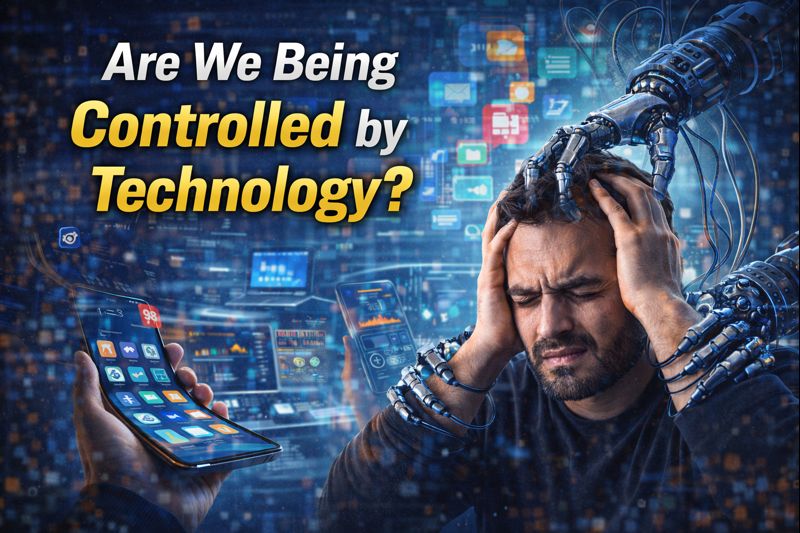
In an era defined by constant connectivity and groundbreaking innovations, a pressing question echoes through our increasingly digital lives: are we being controlled by technology? From the moment we wake to our smart alarms to the AI-driven recommendations shaping our entertainment choices, technology is deeply woven into the fabric of our daily existence in 2026. This pervasive influence prompts a critical examination of its role: are we truly the masters of our tools, or have these tools begun to subtly, yet profoundly, dictate our behaviors, thoughts, and even our societal structures? This article delves into the complex relationship between humanity and its technological creations, exploring the nuanced ways in which our devices and platforms exert control, and what it means for our autonomy and future.
Technology’s influence extends beyond convenience, shaping our behaviors, decisions, and social interactions in 2026.
Algorithmic control, data collection, and persuasive design are key mechanisms through which technology exerts its power.
The debate isn’t about outright control, but rather the subtle ways our choices are nudged and preferences are influenced.
Developing digital literacy, critical thinking, and practicing mindful technology use are crucial for maintaining autonomy.
Ethical development and thoughtful regulation of technology are essential for a balanced human-tech future.
The Digital Tether: Understanding Technology’s Pervasive Reach
The year 2026 finds us surrounded by an unprecedented level of technological integration. Smart homes anticipate our needs, self-driving cars promise effortless commutes, and artificial intelligence assists in everything from medical diagnoses to creative endeavors. This omnipresence often blurs the lines between assistance and dependence. While technology offers undeniable benefits, enhancing productivity, facilitating communication, and solving complex problems, its ever-growing sophistication raises concerns about our diminishing agency.
The question “are we being controlled by technology?” isn’t a simple yes or no. Instead, it invites a deeper look into the mechanisms of this control: how it manifests, its implications for individual freedom, and the societal shifts it precipitates. This journey will explore various facets, from the allure of social media algorithms to the ethical dilemmas of AI decision-making.
The Evolution of Control: From Tools to Tyrants?
Historically, tools were extensions of human capabilities – a hammer made us stronger, a wheel made us faster. Modern technology, however, transcends mere extension. It now processes information, makes recommendations, and even learns from our interactions. This shift introduces a new dynamic where technology isn’t just a passive instrument but an active participant in shaping our world. The narrative often swings between utopian visions of a technologically advanced society and dystopian fears of a future where humans are subservient to their creations. Understanding this spectrum is vital to addressing the core question.
Algorithmic Governance: The Invisible Hand of AI
Perhaps the most potent form of technological influence today comes from algorithms. These complex sets of rules dictate what we see, hear, and even think online. From social media feeds to streaming service recommendations, algorithms are constantly at work, tailoring our digital experiences. But where does personalization end and control begin?
Social Media: Curated Realities and Echo Chambers
Social media platforms are prime examples of algorithmic control. Their goal is to maximize engagement, often by showing users content that aligns with their existing beliefs and preferences. While this can make platforms feel more "relevant," it also creates echo chambers, limiting exposure to diverse viewpoints and potentially reinforcing biases [1]. For instance, a user interested in specific news topics might only see content from sources that confirm their existing opinions, making it harder to critically evaluate information. Readers exploring being controlled unpacking often end up considering accenture navigating digital frontier as part of the same topic. This curated reality impacts not only individual perspectives but also collective understanding and democratic discourse.
Consider how these platforms affect mental well-being; learn more about how technology can cause anxiety and its broader impact.
Recommendation Systems: Guiding Our Choices
Beyond social media, recommendation engines on e-commerce sites, streaming platforms, and even news aggregators play a significant role. They analyze past behavior, preferences, and data from similar users to suggest products, movies, articles, and more.
“The more data these systems collect about us, the better they become at predicting our desires, sometimes even before we consciously recognize them.”
While convenient, these systems can narrow our horizons, gently nudging us towards certain choices and away from others. Are we truly choosing freely when our options are heavily filtered and ranked by an unseen algorithm? This raises the question of whether our independent thought is being subtly eroded by systems designed to predict and satisfy our immediate gratification.
Dataveillance and the Loss of Privacy
The digital age is characterized by an unprecedented collection of personal data. Every click, every search, every purchase, and every location ping contributes to a vast ocean of information about us. Companies leverage this data to refine algorithms, target advertisements, and develop new services. But what are the implications of such pervasive dataveillance for individual autonomy?
The Panopticon Effect: Always Being Watched
The concept of the “digital panopticon” suggests that knowing we are constantly being monitored, even implicitly, can alter our behavior. We might self-censor, conform to perceived norms, or avoid expressing unpopular opinions online, fearing repercussions or unwanted attention. This constant surveillance, often consented to through lengthy terms and conditions that few read, creates a subtle pressure to align with the dominant digital narrative.
Predictive Policing and AI in Decision-Making
The use of AI in areas like predictive policing and credit scoring further illustrates how data can be used to control or limit individuals. Algorithms, fed with historical data, can identify “hot spots” for crime or assess creditworthiness. However, if the underlying data contains biases, the AI can perpetuate and even amplify those biases, leading to discriminatory outcomes for certain groups [2]. This moves beyond mere influence into a realm where technological systems can directly impact life opportunities and freedoms, making the question of “are we being controlled by technology?” even more urgent.
The Psychology of Persuasion: Designing for Dependence
Technology isn’t just smart; it’s often designed to be persuasive. Tech companies employ psychologists and behavioral scientists to craft user experiences that maximize engagement and cultivate habits. This “persuasive design” can be a powerful, often subconscious, form of control.
Hook Models and Habit Formation
Many popular apps and services utilize “hook models” – cycles of triggers, actions, variable rewards, and investment – to create strong user habits. Notifications (triggers) prompt us to open an app (action), where we might find new likes or messages (variable rewards), leading us to invest more time or data into the platform. Over time, these cycles can lead to compulsive use, making it difficult to disengage even when we wish to.
“Technology’s most potent form of control isn’t through force, but through finely tuned persuasion that shapes our habits and desires.”
Understanding how these mechanisms work is crucial to reclaiming autonomy. It’s about recognizing when technology is serving our needs versus when it’s manipulating our attention for its own ends. The way technology affects our daily lives is a complex topic; explore more about how technology affects our daily lives.
Gamification: Turning Life into a Game
Gamification, the application of game-design elements and game principles in non-game contexts, is another persuasive technique. Fitness trackers award badges, language learning apps offer streaks, and productivity tools give points. While motivating, these systems can also dictate behavior, pushing users to engage in activities primarily for the digital reward rather than intrinsic motivation. This external locus of control can subtly shift our priorities, making us dependent on the app’s metrics for validation.
Automation and Autonomy: The Future of Work and Skill
As technology advances, particularly in robotics and artificial intelligence, automation continues to transform industries and redefine human roles. This shift brings both promises of increased efficiency and fears of job displacement and deskilling.
AI in the Workplace: Assistants or Overlords?
In 2026, AI tools are widely integrated into workplaces, from automating routine tasks to assisting in complex decision-making. While they can boost productivity and free up human workers for more creative tasks, they can also dictate workflows, monitor performance, and even evaluate employees. The question then arises: are these AI systems merely tools, or do they exert a form of control over the human workforce, setting standards and expectations that humans must meet?
The Erosion of Skills: Relying on Tech for Basic Functions
As technology increasingly handles complex cognitive tasks, there’s a concern about the potential erosion of human skills. GPS systems reduce our spatial reasoning, spell checkers diminish our grammar skills, and advanced calculators lessen our mental math abilities. While convenient, this dependence can leave individuals vulnerable when technology fails or is unavailable. This subtle deskilling is a form of control, making us reliant on technology for functions we once performed ourselves.
Are We Being Controlled by Technology? A Balanced Perspective
The evidence suggests that while we are not being overtly controlled in a dystopian, sci-fi sense, technology certainly exerts significant, often subtle, influence over our lives in 2026. This influence manifests through:
Algorithmic Nudging: Guiding our choices and perceptions.
Data Exploitation: Leveraging our personal information for targeted outcomes.
Persuasive Design: Cultivating habits and dependencies.
Automation: Reshaping our work and potentially eroding certain skills.
It’s a form of soft control, where choices are framed, options are prioritized, and behaviors are incentivized. The danger isn’t that technology will force us into actions, but that it will subtly shape our desires and limit our perceived alternatives, making us want to do what it has been designed to encourage.
Benefits of Technological Influence
It’s important to acknowledge that not all influence is negative. Many technological advancements genuinely benefit society:
Enhanced Connectivity: Bridging distances and fostering global communities.
Access to Information: Democratizing knowledge and learning.
Improved Health and Safety: Through medical and automotive technologies.
Efficiency and Productivity: Streamlining tasks in personal and professional lives.
The challenge lies in harnessing these benefits while mitigating the risks of excessive control and maintaining human agency.
The Role of Regulation and Ethics
The rapid pace of technological development often outstrips the ability of society and law to keep up. In 2026, there is a growing global conversation around the ethical implications of AI and data use. Regulatory frameworks like GDPR and ongoing discussions about AI ethics aim to establish boundaries and ensure technology serves humanity rather than dominating it. These efforts are critical in shaping a future where technology remains a tool for empowerment.
Reclaiming Autonomy in a Tech-Driven World
Understanding the mechanisms of technological control is the first step toward reclaiming autonomy. It’s not about rejecting technology, but about engaging with it mindfully and critically.
How to Reclaim Autonomy in a Tech-Driven World
Step 1:Digital Detoxes
Regularly disconnect from devices to reset mental habits and reconnect with the physical world.
Step 2:Critical Media Literacy
Question the information presented by algorithms. Seek out diverse sources and verify facts independently.
Step 3:Mindful App Usage
Be aware of how apps are designed to hook you. Turn off unnecessary notifications.
Step 4:Privacy Settings Review
Regularly check and adjust privacy settings on all platforms and devices to limit data collection.
Step 5:Develop Alternative Skills
Don’t let technology entirely replace basic cognitive skills. Practice mental math, navigation, and critical thinking.
Step 6:Support Ethical Tech
Opt for products and services from companies that prioritize user privacy and ethical AI development.
Step 7:Engage in Dialogue
Participate in discussions about technology’s impact and advocate for responsible innovation.
By adopting these practices, individuals can proactively shape their relationship with technology, ensuring it remains a servant and not a subtle master. This mindful approach can help mitigate some of the negative side effects of technology, a topic explored further in how technology is bad for us.
The Path Forward: Human-Centric Technology
Ultimately, the future of our relationship with technology depends on conscious choices – both by individuals and by those who design and govern these powerful tools. A human-centric approach to technology development prioritizes well-being, autonomy, and ethical considerations over pure engagement metrics or profit. This involves:
Transparency: Making algorithmic decision-making processes more understandable.
Accountability: Holding developers and companies responsible for the societal impact of their creations.
User Empowerment: Giving users more control over their data and digital experiences.
Education: Equipping individuals with the skills to navigate the digital world critically.
It’s about striving for a future where technology empowers humanity without inadvertently controlling it.
Conclusion
The question “are we being controlled by technology?” elicits a nuanced answer in 2026. While we are not subjugated by sentient machines, we are undeniably influenced and subtly steered by the algorithms, data, and persuasive designs embedded within our digital tools. This influence shapes our choices, our perceptions, and even our social fabric. The pervasive nature of modern technology means that true control isn’t about direct force but about the careful orchestration of our attention, habits, and preferences.
However, recognizing this reality is empowering. It calls for a conscious effort to cultivate digital literacy, critical thinking, and mindful engagement. By understanding how technology works, exercising our autonomy in digital spaces, and advocating for ethical development, we can ensure that technology remains a powerful force for good – a tool that serves human flourishing rather than dictating our existence. The future relationship between humanity and technology is still being written, and through informed choices, we can collectively steer it towards one of empowerment, not control.
Actionable Next Steps
Review Your Digital Habits: Take stock of how much time you spend on different apps and devices. Identify areas where you might be passively consuming content rather than actively engaging.
Educate Yourself: Learn more about the specific algorithms that shape your online experience. Many platforms offer transparency reports or settings explanations.
Experiment with Control Settings: Explore the privacy and notification settings on your smartphone and frequently used apps. Customize them to better suit your needs and reduce unwanted distractions.
Support Initiatives for Ethical AI: Look for organizations or policies advocating for responsible technology development and data privacy.
Engage in Offline Activities: Actively schedule and participate in activities that do not involve screens to foster diverse interests and reduce digital dependence.
References
[1] Pariser, E. (2011). The Filter Bubble: How the New Personalized Web Is Changing What We Read and How We Think. Penguin Press.
[2] O’Neil, C. (2016). Weapons of Math Destruction: How Big Data Increases Inequality and Threatens Democracy. Crown.
Frequently Asked Questions about Technological Control
Are we being overtly controlled by technology in 2026?
No, not in an overt, dystopian sense. However, technology exerts significant, often subtle, influence over our lives through algorithms, data collection, and persuasive design, guiding our choices and perceptions.
How do algorithms control what we see online?
Algorithms analyze past behavior, preferences, and data from similar users to curate content for social media feeds, search results, and recommendation systems, maximizing engagement and often reinforcing existing beliefs.
What is ‘persuasive design’ in technology?
Persuasive design refers to the psychological techniques used in app and software development to encourage specific user behaviors, like increased engagement, habit formation, and prolonged usage, often through ‘hook models’ and gamification.
Can technology lead to a loss of human skills?
Yes, over-reliance on technology for tasks like navigation, spelling, and mental calculation can lead to a subtle erosion of corresponding human cognitive skills. This dependence can make individuals vulnerable if technology fails.
How can individuals reclaim autonomy from technological control?
Individuals can reclaim autonomy through digital detoxes, critical media literacy, mindful app usage, regularly reviewing privacy settings, developing alternative skills, and supporting ethical tech development.
Key Defined Terms
Algorithmic Control
The process by which complex sets of rules (algorithms) dictate the content, recommendations, and information users encounter online, subtly guiding their choices and perceptions to maximize engagement or achieve specific outcomes.
Persuasive Design
The application of psychological principles and behavioral science in the creation of user interfaces and experiences, aimed at influencing user behavior, forming habits, and increasing engagement with technology.
Digital Panopticon
A metaphorical concept describing the pervasive, often invisible, surveillance and data collection in the digital age, where individuals may alter their behavior due to the awareness that their online activities are constantly being monitored.
Echo Chamber
A situation, especially online, where beliefs are amplified or reinforced by communication and repetition inside a closed system, often due to algorithmic filtering, leading to reduced exposure to conflicting viewpoints.